Mobile Addiction Is Silently Destroying Childhood
How excessive screen time affects children’s brain, mental health, behaviour, sleep, and family bonding - warning signs every parent must know.
By Shwetha B R | 09, May, 2026 05:56 PM
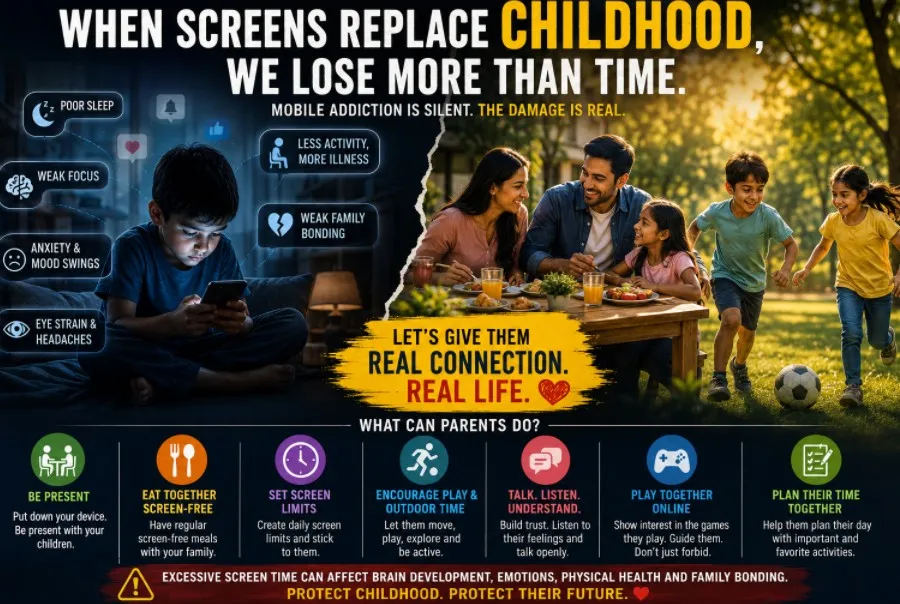
A few years ago, children cried to go outside and play.
Today, many children cry when their parents take away a mobile phone.
This change did not happen overnight.
It entered homes quietly during mealtime, while studying, before sleep, while travelling, and even during family conversations.
At first, the phone became a quick way to calm children. Then it became entertainment. Later, it became a habit. Now, for many children, it has become difficult to stay away from it even for a short time.
Many children today spend more time touching screens than holding real hands.
And that is where the real concern begins.
Why Are Children Getting Addicted So Easily?
Children’s brains are naturally curious. Every game, short video, notification, or “like” gives the brain a small feeling of excitement and pleasure.
Researchers explain that many games and social media platforms work on a reward pattern like gambling systems. Children never know what exciting thing will appear next, so the brain keeps asking for “one more minute.”
The problem is that a child’s self-control system is still developing. They do not yet fully understand limits, balance, or long-term effects.
That is why addiction grows quietly before parents even realise it.
The Warning Signs Many Families Ignore:
Mobile addiction rarely begins with extreme behaviour. It usually starts with small changes.
- Children become restless or angry when phones are removed.
- Outdoor play has decreased.
- Sleep timings change.
- Meals become impossible without videos.
- Attention span becomes weaker.
- Studies lose importance.
- Conversations become shorter.
- Patience decreases.
Some children now sit silently beside grandparents while scrolling phones, missing stories they may never hear again.
Some families sit together in the same room, yet everyone lives in a different digital world.
This is not just a loss of time.
It is a loss of connection.
How Mobile Addiction Affects the Brain and Mental Health:
Excessive screen exposure affects the developing brain in many ways.
Fast-moving videos and constant stimulation train the brain to expect quick pleasure all the time. Because of this, many children struggle with patience, concentration, emotional control, and deep thinking.
Research also links excessive screen time with:
- Anxiety and stress.
- Mood swings.
- Poor focus and memory.
- Sleep disturbances.
- Emotional dependency.
- Loneliness and social withdrawal.
- Increased risk of depression in some children and teenagers.
Children may appear happy while using phones for hours, but internally, many become more irritated, impatient, mentally tired, and disconnected from real-life experiences.
Physical Health Is Also Getting Affected:
The body of a child is designed to move, explore, run, climb, and play.
But today, many children spend long hours sitting in one position staring at a screen.
This can lead to:
- Eye strain and headaches.
- Neck and back pain.
- Poor posture.
- Weight gain.
- Reduced physical activity.
- Weak stamina.
- Disturbed sleep due to blue light exposure.
A healthy childhood cannot grow fully inside a screen.
The Silent Damage to Family Bonding:
One of the biggest losses caused by mobile addiction is weakening family relationships.
Parents are busy with work and phones.
Children are busy with games and videos.
Conversations become shorter.
Eye contact becomes less frequent.
Shared moments slowly disappear.
Many children today know their parents are physically present but emotionally unavailable.
At the same time, many parents feel their children no longer talk openly, laugh freely, or spend quality time with family.
The distance grows silently.
One day, parents may realise they gave their children the best schools, clothes, toys, and devices, but very little uninterrupted time.
What Can Parents Do?
Fighting, shouting, or forcefully snatching phones every day usually creates more anger than understanding.
Children need guidance, routine, emotional connection, and healthy alternatives.
Practical and Psychology-Based Solutions:
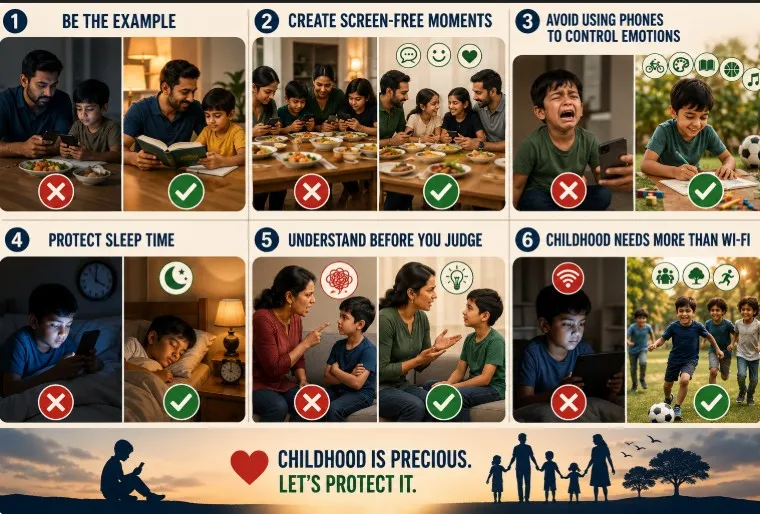
1. Be the Example:
Problem:
Many parents ask children to reduce screen time while they themselves continuously scroll on their phones during meals, conversations, or family time. Children silently observe this contradiction.
Possible Solution:
Parents must first correct their own screen habits before expecting change from children. Keep phones away during meals and family conversations. Instead of scrolling endlessly, let children see parents reading books, writing, gardening, exercising, or spending quality time with family.
Children copy lifestyles more than instructions.
2. Create Screen-Free Moments:
Problem:
Even when families sit together, everyone is busy with their own devices. Emotional bonding slowly becomes weaker without anyone realizing it.
Possible Solution:
Create daily “screen-free zones” or timings at home:
- During meals
- Before bedtime
- During family discussions
- While travelling short distances
Use that time to talk, laugh, share stories, or discuss the day. Children who feel emotionally connected at home usually depend less on virtual entertainment.
3. Avoid Using Phones to Control Emotions
Problem:
Many children receive phones whenever they cry, become bored, restless, or throw tantrums. Slowly, phones become their emotional escape system.
Possible Solution:
Children must learn how to handle boredom, disappointment, waiting, and emotions naturally. Instead of immediately giving a phone, redirect them toward healthier activities:
- Outdoor play
- Drawing
- Reading
- Sports
- Storytelling
- Music
- Family interaction
Boredom is not dangerous. In fact, boredom often develops creativity, imagination, patience, and problem-solving skills.
4. Protect Sleep Time:
Problem:
Many children use phones before sleep, and some secretly continue using them under blankets late at night. Blue light exposure and overstimulation affect sleep quality and brain rest.
Possible Solution:
Keep phones away at least 1 hour before bedtime. Avoid charging devices inside children’s bedrooms. Create calming nighttime routines like the following:
- Reading storybooks
- Talking about the day
- Soft music
- Simple breathing exercises
Good sleep is not laziness. It is essential for brain development, emotional balance, memory, concentration, and healthy growth.
5. Understand Before You Judge
Problem:
Constant scolding like “Phone is bad” or “You are addicted” often creates resistance, anger, or secrecy instead of real understanding.
Possible Solution:
Children respond better to calm conversations than fear-based control. Explain how excessive screen time affects:
- Brain development
- Focus and memory
- Emotions
- Sleep
- Physical health
- Relationships
When children understand the reason behind rules, cooperation becomes easier.
6. Childhood Needs More Than Wi-Fi
Problem:
Many children are becoming connected to devices but disconnected from real life. Physical activity, conversations, outdoor experiences, patience, and emotional bonding are slowly decreasing.
Possible Solution:
Parents must intentionally create real-life experiences that screens cannot replace:
- Family walks.
- Outdoor games.
- Cooking together.
- Visiting grandparents.
- Nature trips.
- Creative hobbies.
Meaningful conversations.
![]()
A Small Reflection:
A child may forget many videos watched online.
But they will always remember how they felt with their family.
Technology is not the enemy.
The real danger begins when screens replace childhood itself.
A mobile phone should remain a tool in a child’s life not become the child’s entire world.
Because some losses cannot be repaired later.
If we do not protect childhood today, tomorrow we may raise a generation that knows how to use devices… but struggles to understand emotions, relationships, patience, and life itself.

Thank you so much for reading this article
If you have faced mobile addiction issues at home or found any effective ways to reduce screen time for children, do share your experiences and solutions in the comments. Your small insight may help another family protect their child’s childhood and mental well-being.