The Hidden Psychology Behind Child Behavior Most Adults Fail to Understand
Understanding what your child’s behavior is really trying to say and how your response shapes their emotional world
By Shwetha B R | 13, May, 2026 01:18 PM
Have you ever wondered why a child cries, shouts, throws things, or refuses to listen… even after being told calmly?
Sometimes the reason looks very small.
Yet the reaction feels very big.
And slowly, frustration grows, not only inside the child but also inside the parent too.
You explain patiently.
You repeat yourself again and again.
Still, the behaviour continues.
At some point, many parents silently think:
“Why is my child becoming so difficult?”
But what if the real problem is not the behaviour you see…but the emotion hidden behind it?
What Most Parents See… and What the Child Actually Feels
We often label children very quickly.
Stubborn, naughty, disobedient, and attention-seeking.
But psychology shows us something deeper.
A child’s brain is still developing. The emotional part of the brain becomes active much earlier than the reasoning part. That means children feel emotions very intensely, but they do not yet know how to manage or explain those emotions properly.
Adults can say:
“I feel stressed",
“I feel ignored",
“I had a bad day.”
Children usually cannot.
So instead of expressing emotions through words, they express them through behaviour.
A Situation Many Parents Experience:
One common example happens after school.
A child comes home tired, emotionally exhausted, and hungry.
The parent asks them to switch off the TV, complete homework, or eat properly.Suddenly, the child shouts, throws things, cries loudly, or refuses to listen.
From the outside, it looks like the child is reacting badly to a small situation.
But many times, the real reason is not the homework or the TV.
The child may already be carrying emotional stress from the entire day pressure in school, fear of mistakes, difficulty with friends, feeling compared, or simply mental exhaustion.
Since children cannot always explain these feelings clearly, the emotions come out through behaviour.
What looks like “bad behaviour" may actually be an emotionally overwhelmed child asking for comfort, patience, and understanding.
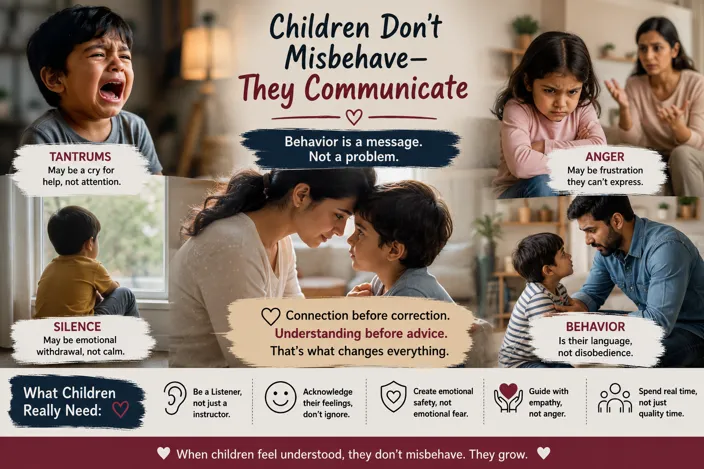
That tantrum may not really be about the chocolate or toy.
It may be frustration that has been building for hours.
That sudden anger may not be disrespect.
It may be emotional overload.
That silence may not mean the child is calm.
Sometimes, silence is sadness that has no words.
Why Children React Emotionally
Children are emotionally sensitive human beings.
They notice much more than adults realise.
They notice:
- The tone of your voice.
- How do you react when they make mistakes?
- Do you listen fully or interrupt quickly?
- Does home feel emotionally safe or emotionally tense?
Many parents think children “forget quickly".
But emotionally, children absorb deeply.
A child who constantly hears the following:
“Stop crying.”
“Why are you always like this?”
“Don’t behave like a baby.”
May slowly begin to feel the following:
“My emotions are wrong.”
“No one understands me.”
“I should hide my feelings.”
This is how emotional distance silently begins.
The Mistake Many Parents Make Without Realizing
Most adults try to correct behaviour immediately.
“Stop shouting.”
“Behave properly",
“Go sit there quietly.”
But very few pause and ask:
“What is my child trying to communicate?”
Children do need discipline.
They need boundaries.
They need guidance.
But discipline without emotional understanding often creates fear instead of emotional growth.
A child may stop expressing emotions in front of you not because they have learned emotional control. But because they no longer feel emotionally safe.
And this becomes dangerous later.
Some children become emotionally distant.
Some become aggressive.
Some become anxious people-pleasers.
Some struggle silently for years.
Many emotionally wounded adults were once children who felt unheard repeatedly.
What Children Actually Need From Parents
Children do not expect perfect parents. They need emotionally available parents.
Parents who:
- Listen before judging.
- Correct without humiliating.
- Stay calm during emotional moments
- Make children feel safe even during mistakes
This does not mean saying “yes” to everything.
Understanding emotions is not the same as allowing bad behaviour.
A child can be corrected with firmness and kindness together.
For example:
Instead of saying:
“Stop crying right now.”
A calmer response could be the following:
“I can see you are upset. Let us talk after you calm down.”
One sentence controls behaviour.
The other understands emotion while guiding behaviour.
That difference matters more than many people realise.
Why Emotional Safety Matters So Much
A child who feels emotionally safe at home learns confidence naturally.
Because emotional safety teaches children:
- How to express feelings?
- How does one regulate emotions?
- How to trust relationships
- How to handle mistakes without fear
Children learn emotional control not only from instructions but also by watching how adults handle emotions.
If parents react with shouting, children learn shouting.
If parents react with patience, children slowly learn patience too.
Children copy emotional behaviour more than advice.
Conclusion:
Behind every child’s behaviour, there is usually an emotion asking to be understood.
Not every tantrum is manipulation.
Not all anger is disrespect.
Not every silence means everything is fine.
Sometimes, behaviour is simply a child’s way of saying:
“Please listen to me.”
“Please understand me.”
“Please stay with me.”
And when parents begin to see behaviour as communication instead of just disobedience, something beautiful starts changing.
The child feels safer.
The connection becomes stronger.
The home becomes emotionally healthier.
Because in the end, children may forget many things from childhood…
But they rarely forget how their parents made them feel.