Self-Control: The Quiet Strength That Can Change Your Life
Why learning to manage your thoughts, emotions, and actions is one of the most powerful life skills you can develop
By Shwetha B R | 19, Aug, 2026 12:09 PM
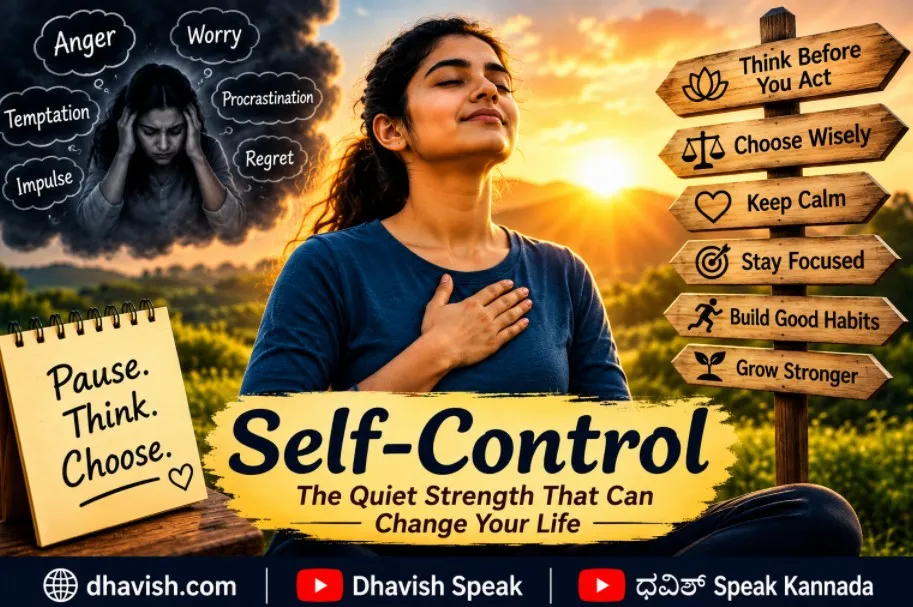
Have you ever said something in anger and wished you could take it back?
Have you ever promised yourself, “I won’t do it again,” only to repeat the same habit?
Maybe you delayed something important or reacted harshly when someone hurt you.
These moments are more common than we admit.
The problem is not that we have emotions or distractions. We are human. The real challenge is learning how to respond without allowing them to control us.
That is where self-control begins.
What Is Self-Control?
Self-control is the ability to manage our thoughts, emotions, and actions, especially when our immediate feelings pull us in another direction.
It does not mean suppressing emotions or becoming emotionless.
It means being able to say, “I feel angry, but I don’t have to act angrily. I want to give up, but I can take one more step. I want this now, but I know what is better for me in the long run.”
Psychologically, self-control is the ability to pause between a feeling and a response. That small pause can change the outcome.
The Power of the Pause
Imagine someone says something insulting to you.
Your mind immediately prepares a reply. You want to prove that you are right.
But if you pause, breathe, and think before responding, something changes.
You are no longer simply reacting.
You are choosing.
That is the real power of self-control. A person with self-control is not someone who never gets angry, but someone who knows what to do with that anger.
Sometimes silence is wiser than an argument. Sometimes walking away is stronger than fighting. Sometimes saying, “I need some time to think,” is better than saying something you will regret.
Self-Control Protects Us From Temporary Feelings
Self-control matters because emotions are temporary, but their consequences may not be.
Anger may last for a few minutes, but harsh words can remain in someone’s heart for years.
A moment of temptation may feel exciting, but a poor decision can create long-term problems.
Procrastination may feel comfortable, but repeated procrastination can slowly damage our confidence and goals.
Self-control is not about denying pleasure. It is about choosing long-term peace over short-term comfort.
Self-Control and Our Goals
Every meaningful goal requires self-control.
Whether it is studying, becoming healthier, or building a career, we have to keep making better choices even when distractions, temptations, or slow results make it difficult.
Dreams are easy to imagine, but discipline is what turns them into reality.
Self-control helps us stay committed when motivation disappears. You cannot depend on feeling motivated every day. Sometimes you simply need to tell yourself, “I don’t feel like doing this, but I know it needs to be done.”
Self-Control Improves Relationships
Many relationships are damaged not because people stop loving each other, but because they stop controlling their reactions.
We speak without thinking. We judge too quickly. We bring yesterday’s anger into today’s conversation. We say things just to win an argument.
Healthy relationships require emotional control.
Before replying to someone, ask yourself:
“Am I trying to solve the problem, or am I simply trying to prove that I am right?”
That one question can prevent unnecessary conflicts. Self-control teaches us that not every thought needs to become words or every emotion become an action.
Self-Control Is a Skill, Not a Personality Trait
Perhaps the most important thing to understand is this:
You are not simply born with self-control. It can be developed.
Like any skill, it becomes stronger with practice.
Start small: wait before responding when angry, keep your phone away while working, take deep breaths when emotions run high, and say no to choices that pull you away from your goal.
Every small act of self-control strengthens you.
And when you fail and you will sometimes- don’t turn one mistake into an identity.
Instead of saying, “I have no self-control,” ask:
“What triggered me, and what can I do differently next time?”
That shift from self-judgment to self-awareness is important for emotional growth.
The Strongest Person Is Not the One Who Controls Others
We often think strength means controlling others or circumstances.
But real strength begins much closer to home:
controlling ourselves.
You cannot control what people say, every situation, or how life unfolds.
But you can work on controlling your response.
You can choose patience over anger, discipline over excuses, silence over unnecessary arguments, and long-term happiness over temporary pleasure.
Self-control does not make life perfect. It makes you stronger when life becomes difficult.
Its greatest gift is that every time you pause instead of reacting, choose discipline over temptation, or walk away from regret, you become a stronger version of yourself.
You don’t need to control the whole world to change your life.
Start by learning to control the one person you can truly influence: yourself.