Bonding with Your Baby Before Birth: What Science Says
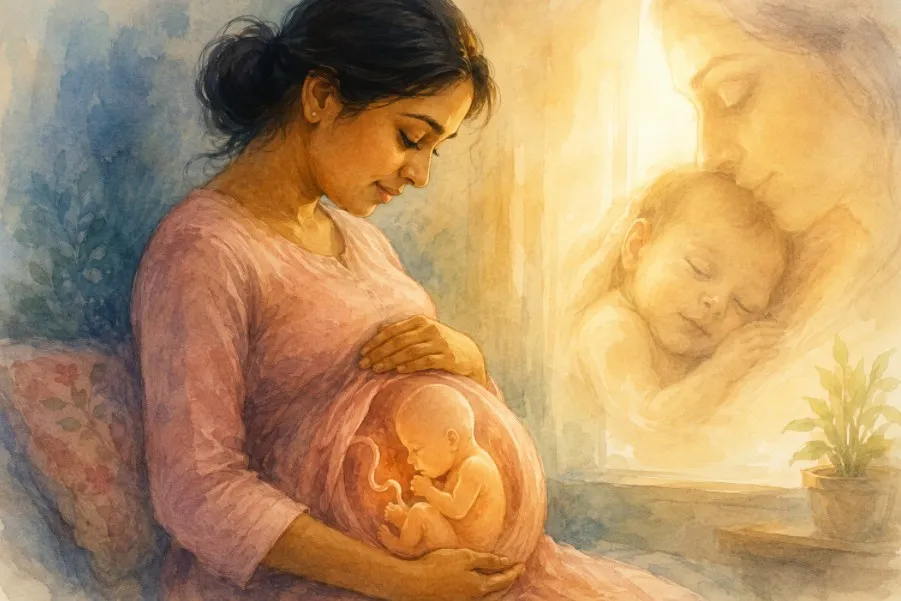
The relationship between a parent and a child begins long before the first embrace.
By Shwetha B R | 22, Aug, 2026 05:08 AM

Your baby has never seen your face.
Yet, by the time you finally hold your little one, the journey of knowing you has already
begun.
It sounds unbelievable.
How can a baby who has never opened its eyes to the world already recognize its mother?
Can love, comfort, and connection begin before birth?
For many years, pregnancy was viewed mainly as a period of physical growth. The baby was
thought to be quietly developing until the day of birth.
Today, child psychology and neuroscience tell us a much more beautiful story.
A baby in the womb is not simply growing. It is listening, sensing, learning, and gradually
building its first relationship with the people waiting outside.
This bond is invisible.
Yet it may become one of the strongest relationships in life.
Bonding Begins Earlier Than Most People Imagine
Many parents believe bonding starts when they first hold their baby.
Some think it begins with breastfeeding.
Others believe it starts after the baby smiles for the first time.
But research suggests that bonding often begins months before birth.
Around the second half of pregnancy, a baby’s hearing develops enough to recognize sounds
from the outside world. The mother’s heartbeat becomes a constant rhythm. Her voice is
heard more often than any other sound.
Over time, these sounds become familiar.
Scientists have found that many newborn babies show a preference for their mother's voice
within hours of birth. Some studies even suggest they recognize stories or songs that were
repeated during pregnancy.
The baby has never met the mother.
Yet the mother is already the most familiar person in the baby’s world.
The First Language Is Not Words
Parents often wonder what they should say to the baby during pregnancy.
The answer is surprisingly simple.
It is not the words that matter most.
It is the feeling behind them.
A mother softly talking to her baby while preparing dinner.
A father saying, We’re waiting for you.
A family laughing together in the evening.
The baby may not understand language.
But it is growing in an environment filled with voices, rhythms, and emotional experiences.
Psychologists believe that these repeated, comforting experiences help create familiarity and
emotional security long before birth.
The baby’s first language is not English, Kannada, or any other spoken language.
It is warmth.
It is rhythm.
It is connection.
Why a Father’s Voice Matters Too
Many people assume pregnancy is only about the mother and the baby.
But science tells us another interesting story.
If a father regularly talks, sings, or reads to the baby during pregnancy, that voice can also
become familiar.
After birth, some newborns calm more quickly when they hear voices they frequently heard
before they were born.
This does not happen overnight.
It develops through repetition.
A few minutes of gentle conversation every day may seem insignificant to adults.
To a growing baby, those moments become part of its earliest experiences.
Bonding is not created in one grand moment.
It is built through many small moments repeated with love.
Love Changes the Brain Too
One of the most fascinating discoveries in psychology is that bonding does not only influence
the baby.
It also changes the parents.
When parents spend time thinking about, talking to, or emotionally connecting with their
unborn child, the brain releases hormones such as oxytocin, often called the bonding
hormone.
Oxytocin helps parents feel more connected, reduces stress, and prepares them emotionally
for caring for their baby after birth.
In other words, while the baby is growing physically inside the womb, the parents are also
growing emotionally into their new role.
Pregnancy is creating a family - not just a child.
Bonding Does Not Require Perfection
Some parents worry after reading articles like this.
I was busy during pregnancy.
I did not always talk to my baby.
I was stressed.
I wasn’t emotionally connected in the beginning.
If that sounds familiar, take a deep breath.
Bonding is not a test.
It is not measured by how many songs you sang or how many conversations you had.
Healthy attachment continues to grow after birth through cuddling, feeding, eye contact,
comforting, and everyday care.
The months before birth are the beginning of the journey - not the final opportunity.
Every loving moment, whether before birth or after, strengthens the relationship.
Small Moments That Create Lasting Memories
You do not need expensive products or complicated techniques to bond with your unborn child.
baby.
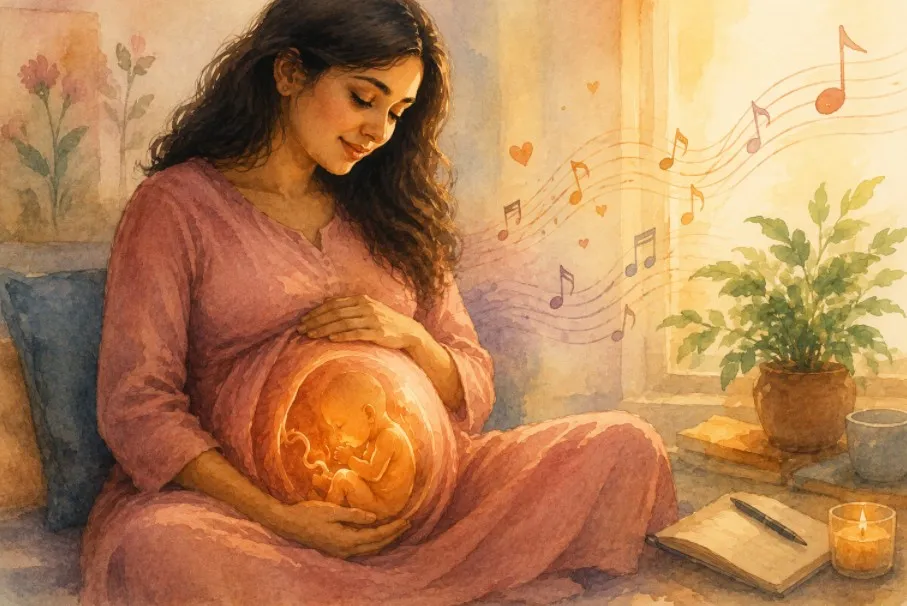
Sometimes it is as simple as placing a hand on your belly before sleeping.
Talking about your hopes.
Listening to calming music together.
Taking a quiet walk.
Reading a favorite story aloud.
Smiling while imagining the little life growing inside.
These moments may seem ordinary.
But they help parents slow down, become emotionally present, and begin building a
relationship that will continue for a lifetime.
A Bond That Begins Before the First Hug
One day, your baby will finally open tiny eyes and look at you for the first time.
It will feel like the beginning.
It is a continuation of a relationship that has already been quietly growing for
months.
The familiar heartbeat.
The comforting voice.
The gentle laughter.
The calm moments.
The loving conversations.
These become part of the baby's earliest experiences, even before birth.
Science cannot measure every emotion between a parent and a child.
But it continues to reveal something extraordinary.
Bonding doesn't suddenly appear in the delivery room.
It begins in the quiet moments of pregnancy, grows through everyday acts of love, and
becomes the foundation of trust, emotional security, and healthy attachment.
Perhaps that is the real miracle of pregnancy.
Before a baby reaches for your hand...
It has already begun reaching for your heart.